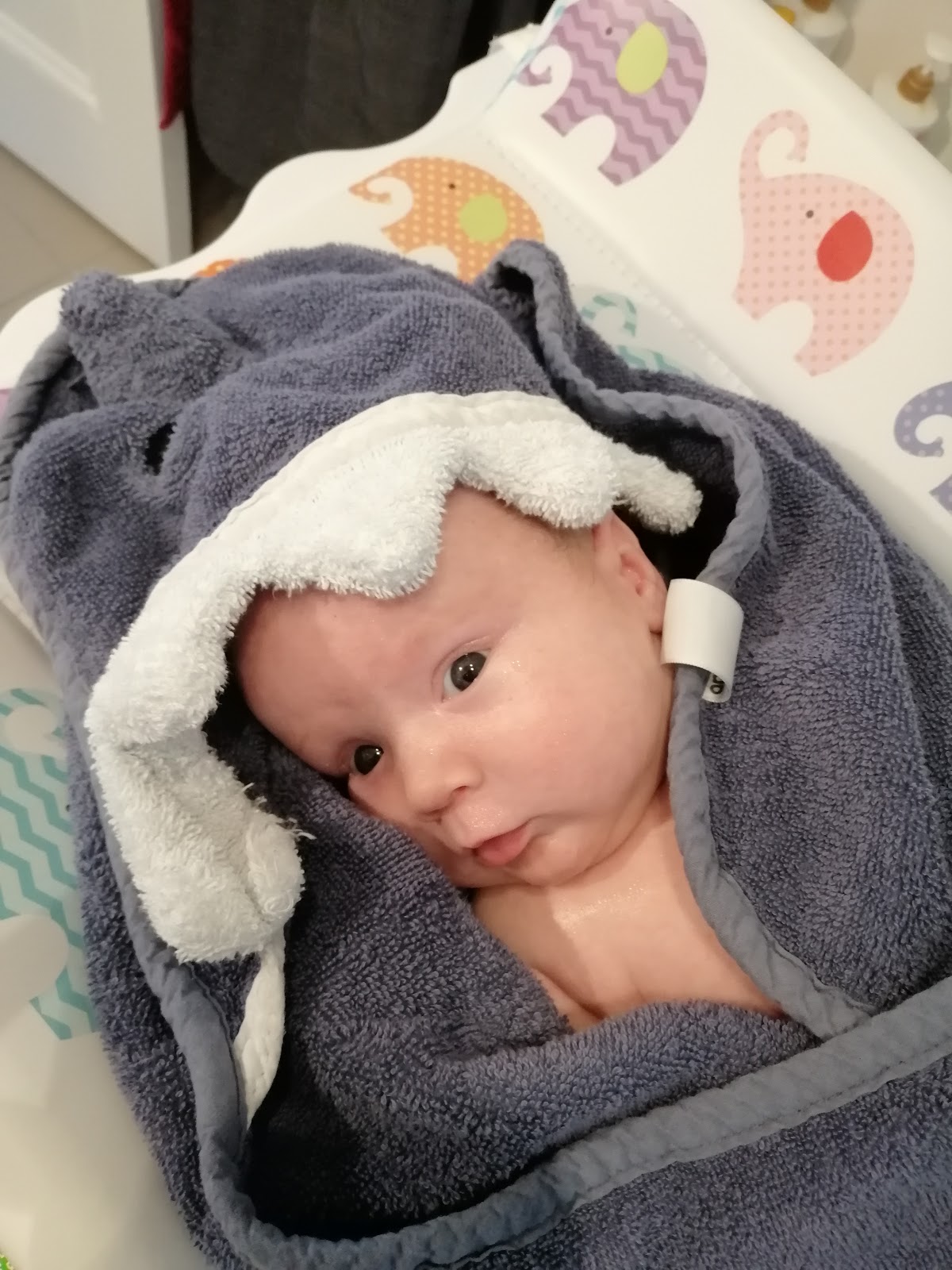
One thing that struck me throughout was the degree to which I'd never really heard people talk about this kind of experience, but once people started finding out what was happening with us a huge proportion of people had similar personal stories to share. I hope documenting the experience might help other people going through similar situations.
4 Weeks
At 4 weeks Fiona found me in the front room of the house and while crying slightly said the classic and unforgettable line "We're going to have a baby". We then began all the normal bits of early pregnancy, like suddenly stocking the fridge with non-alcoholic beverages and thoroughly washing the salad while not mentioning anything to anyone.
7 Weeks
7 weeks was the first scan. We were still at the peak of lockdown, so Fi went by herself. Everything was looking fine, but the fetus was measuring a little smaller than smaller than we had calculated in terms of gestation based on Fi’s last period. Given it was the first scan it meant the official due date was moved a few days further forward than our previous estimates had been. At the time, moving the date didn’t seem like a big deal but it would have significant implications for some of the goals we faced later on.
11 Weeks
At 11 weeks Fiona had a small bleed that triggered the first scary visit to the hospital. Luckily while the ultrasound did show that there had been a small hematoma it didn't seem to have damaged anything and the tiny potential human was still happily growing and swimming around without seeming to notice everyone outside freaking out. It did lead to Fi getting the first of a number of anti D injections that would become a semi regular occurrence due to her negative blood type and concerns about risks that could be shared between parent and child.
16 Weeks
At 16 weeks we started telling people that we had a baby on the way. The numbers said we were past the risky bit and growth on scans was looking good. We were also starting to be able to hear the heart rate on a doppler which was always a comfort.
22 Weeks and 1 Day
Around 6 PM on a Wednesday Fi yelled for me from the bedroom and quickly said she'd just had a large bleed. She was in obvious shock and we knew she needed to get to the hospital. She tried ringing our midwife then sent her a message to say we'd be at the hospital when she couldn't get her. I gathered up our stuff and our flatmate drove us to the hospital.
Arriving at the hospital we ran into a Covid related complication as the after hours entrances had just changed how they were handling the visitors and shuttled us back and forth between multiple entrances before eventually letting us into the first one we'd gone to. Luckily in our case it didn't end up mattering, but it really highlighted how directly the need to respond to covid had directly affected other health provisions.
Once inside, we were found a bed in the delivery suite and our midwife came in to do an initial search for a heartbeat with a doppler. The tense seconds while she tried to find a heartbeat followed by the immense sense of relief when she found it coming through quick and strong is unlike any other experience I've had.
Over the next few hours doctors and midwives came through steadily with various examinations, antibiotics and theories about what could be happening. One of the front-running theories was that Fiona's waters had broken but it could also have just been another hematoma. The prospect of broken waters was especially scary as in most cases labour will begin within 72 hours of waters breaking early and at 22 weeks and 1 day the chance of having a successful delivery is extremely low(Although with progression in medicine no longer exactly 0)
One poor midwife who had the unenviable task of taking rather a lot of blood got very worried when Fi went very pale and flopped backwards onto the bed during the test. Fi had always hated blood tests and the extra stress very nearly lead to her fainting when they were putting a line in.
Somewhere in the course of this process we were officially admitted and Fi was issued a patient wristband. Records show 9:53 pm as the time this occurred, but we’d been in the hospital for at least a couple of hours by that point. Eventually, as everything seemed stable they left us to sleep for a bit before waking us at 6AM to say they needed the room as a dozen women had all shown up in labour at the same time.
22 Weeks and 2 Days
After being woken up we were moved down to the Ante-Natal ward, a place we would become very familiar with over the coming weeks. Fi was given a bed in a room with one other and various followup tests were booked including more ultrasounds and further blood tests.
We also started to get numbers and ideas about potential outcomes at this point. Most of the time people think of of gestational age in weeks but the difference between 22 weeks and 24 weeks in terms of birth outcomes is nearly 50%. Not 50% in the sense of a 50% improvment but 50% in terms of going from a near 0% chance of survivial to 50%. If the baby had come on day one of our stay our chances would have been at the level of winning the lottery and only 2 weeks later we would be flipping a coin.
23 Weeks
We actually got to go home for a couple of days in the weekend with instructions to come back immediately if anything happened and to come back on Monday with anything Fi would need if tests showed enough areas of concern that they'd want her to move into the hospital. We were also still in heightened alert levels so while extra freedom was good it didn't open up a window to see people one last time.
Monday rolled around and the tests reinforced that Fi's waters were mostly likely broken and the medical recommendation was that Fi spend the remainder of her pregnancy in hospital. At that point the doctor's really focussed on a one foot in front of the other approach and clearly believed that we would be doing well to make it to 30 weeks(one of the big cut off points where long term outcomes start getting close to full term outcomes)
The next few days we started settling into the hospital while dealing with the challenges of hospital lockdown from covid still being in effect so I needed to spend a lot of time in the hospital both for the normal level of supporting Fi and to cover for her not really being allowed visitors.
23 Weeks and 6 Days
At 23 weeks and 6 days Fi's infection markers started going up alongside a slight temperature. With her waters broken any infection would be extremely dangerous, the doctor's were concerned enough that we were taken down to the delivery suite and briefed on scenarios.
If the infection didn't respond quickly to antibiotics then they would recommend delivery and while the odds at 23 and 6 were starting to increase they weren't good and there were two different numbers to track. Both the chance that a baby would come out alive and how badly damaged it might be from what it would take to keep it alive. While the earlier discussion of how far we might go to keep a baby alive seemed distant, in the waiting room of delivery suite the numbers suddenly got much more real. All we could do was make some basic decisions and hope the infection markers went back down.
Making the evening even more tense was the knowledge that 24 weeks was a significant cutoff in policy around approach to delivery. At 24 weeks the team would equally balance there treatment to achieve the best balance of outcomes for mother and child, while at 23 weeks and 6 days the balance was kept firmly on the mother. They'd still try and save the baby but with a set of surgical decisions that further decreased the odds of success. In an already stressful situation it's very weird to then have an extra reason to watch the hours tick by with the knowledge that every hour is changing both the actual health situation as well as the policies that will affect the outcomes.
Luckily, as the night wore on, it became clear that the antibiotics being pumped into Fi were doing their job and her infection markers stabilised.
The next day we were trundled back down to the antenatal ward to return to our previously scheduled waiting.
28 Weeks
By 28 weeks Fi had been in hospital for nearly six weeks and we'd settled into something of a routine. I was there daily and often took a many of my meetings from the hospital while on other days I got there a bit later and then quietly stayed in Fi's room until we started getting hints from the midwife's that maybe visiting hours had finished an hour ago and they'd need to stop turning a blind eye to my presence sometime soon.
Somewhere around this point the covid related visiting restrictions also started to ease up which was a huge boon as more people started dropping by both to help Fi keep sane and also to deliver various snacks(Snacks are a high value commodity in Wellington hospital ever since a change in "healthy eating" policy lead to the removal of vending machines from most of the grounds).
(“Meatballs with seasonal vegetables”. Some dishes were quite a bit better than this but plenty were worse as well.)
30 Weeks
30 Weeks was a big milestone as by this point most numbers said that our long term outcomes were nearly the same as a full term baby.
Our biggest ongoing worry was still around his lung development as the lowered amniotic fluid could be hampering that development. Fi had also been leaking a bit more so ultrasounds showed less fluid available but luckily the baby was managing to sit in a way that kept his mouth in the fluid to keep breathing it in and developing his lungs.
We'd also thoroughly adapted to a hospital based routine at this point - where earlier we were feeling the pressure of responding to events and being worried about each day, now we were ticking along. In some ways this was more challenging as it left more time for boredom and frustration to set in. One bright side was that Fi had got so used to her regular blood tests that instead of nearly fainting in response she was now carrying on work calls while the phlebotomist wheeled in their trolley.
32 Weeks and 1 Day
At 32 weeks Fi started feeling a bit sick and the doctors did an extra round of bloodtests. The first day they saw some infection markers going up but decided to hold off on any major decisions, overnight Fi was fine but the next day the markers were up again and Fi wasn't feeling so hot.
As the day progressed Fi was asked to fast "just in case" which progressed to, "probably" the baby needs to come out, and then to "Yes you'll be going to delivery suite tonight". From the time that everything went from keeping a watching brief to us getting shuffled down to delivery suite there was probably only 2 hours in which I quickly finished doing things like the day's payroll and Fi emailed her boss to say she wouldn't actually be dialling into any meetings tomorrow.
As always with hospitals we then had a good few rounds of hurry up and wait as some more drastic emergencies bumped us down the surgery list. What had originally been a 8pm slot came and went with some information that we'd be soon. Eventually at around midnight our slot came up and we wheeled down to the theater. The c-section itself took less than 7 minutes from the first cut to the baby being out and in the corner with his own team to look after him(At peak there were about 15 people in the room covering both the team looking after Fi and the team for the baby).
The team looking after the baby immediately started working on supporting his breathing(We only found out in his discharge notes how bad a condition his lungs had actually been in) while the surgical team started putting Fi's insides back together.
Once they'd completed their immediate work it was time to wheel Finlay(We'd finalised his name in the operating theatre when Fi looked over at me and said "What do you think, does he look like a Finlay?") down to the NICU.
The NICU is a relatively busy place even at 1 in the morning with both a very high nurse to baby ratio and a pretty steady stream of parents who are still there or have come in to drop off milk or breastfeed if their baby is old enough. Not that you notice when you're carefully helping to wheel in your own tiny child though.
I stayed with Finlay until he was settled in and had all his monitoring ticking along at a consistent level he seemed both astonishingly tiny and not since he was sharing a room with babies that were half his size again(He'd come out weighing 2.52 kg which is big for a 32 weeker and also big for the higher risk room that he started his NICU journey in). That first night he had: 4 monitoring wires, 2 iv's, a breathing mask, a feeding tube, goggles and a bright blue lamp to help with jaundice. Many of our small celebrations over the coming weeks would be each time one of those got removed.
By the time I got back to delivery suite Fi had finished being stitched back up and was sucking on an iceblock while automated massaging pillows slowly pumped up and down on her legs.
33 Weeks
The first few days in NICU were something of a blur. Finlay looked tiny and was surrounded by so many wires that just touching him seemed scary. We had to adjust to the constant beeping and frequent alerts that popped up on our screens and the screens around us.
Most concerning for us was when his heart rate and blood oxygen would suddenly drop. A nurse would immediately come over and fiddle with the oxygen dials but it took a while to become used to seeing the numbers suddenly start to drop(They would regularly drop as the goal was always to steadily reduce his dependance on oxygen for which the main strategy was lowering the extra oxygen he was receiving and seeing if he was still getting enough).
While the NICU experience was stressful in its own right it was a lot less stressful than the experience of having Fi in the hospital and not knowing what would happen. The biggest remaining risk had been birth and getting through that put us on a much more stable path as the days started to add up and Fi managed to come home.
34 Weeks
The next few weeks we were visiting the NICU constantly but also didn't have much to do when we were there. A premature baby should still be in the womb so they're still mostly asleep, don't make a lot of noise, and don't really interact(although they can do the finger grabbing thing).
We learned to interpret the large charts that were kept next to the incubator to understand how much he was eating, how much he was growing, and if anything concerning had happened between visits.
From here it was a steady series of improvements with the two biggest goals for getting him home being no longer needing breathing support, and his feeding and growth being far enough along to safely feed him at home. The breathing was a steady series of improvements as he went from full mask to tubes, to little nostril pipes and we could also check the dials each day for how much supplemental oxygen and pressure he was needing each day.
Feeding felt like it took a lot longer to progress as he stayed dependent on the tube for all his feeds for weeks and also had the most difficulty breathing during feeds. Luckily he was managing to eat a lot despite these challenges so his growth was steady and doctors were confident his eating would come right eventually.
37 Weeks and 6 Days
With Finlay's health improving we started to prepare for the end of his stay in the NICU. One of the final activities was "rooming in '' a process where parents and baby get a room to themselves to adapt to childcare and taking over cares(cares has a unique meaning in NICU to cover all of the regular activities that happen on a regular cycle as part of taking care of the baby such as: wiping the eyes since prem babies don’t have their tear ducts going yet, wiping the face, nappy changes, temperature checks etc) while still being checked on regularly by nurses and with help on immediate hand if anything goes wrong.
Initially, our goal for this week was to get completely off the feeding tube and be able to go home without it. Unfortunately, after a couple of distressing 2am marathons trying to get him to do his night feeds under his own power, it became clear he was still a few days away from not needing the tube. Happily for us the nurses felt we'd gained enough skill at managing a feeding tube that we could take him home with it still in.
38 Weeks and 4 Days
At 38 weeks and 4 days, after essentially 16 weeks of being tethered to the hospital we got to take Finlay home. He was making good progress on growth and although we did take him home with the feeding tube(and needed it the first couple of nights) he managed to transition to normal feeds within a week.
40 Weeks
By the time Finlay's original due date came along he'd been out of the womb for nearly 8 weeks. But it had been a different kind of experience, as while he'd started interacting in some ways he was only just finishing off a lot of the development that should have been happening within the womb.
People asked about things like his affect on sleep or keeping us up but in reality he only started being able to make a level of noise that wake up whichever parent wasn't with him once he reached about 40 weeks. While most people tracked their child on a growth curve we essentially had three different ones:
- His age since birth - which was a good track of some types of development like neck strength which had improved as soon as he was out of the womb and needed to use his muscles to lift his head.
- His corrected gestational age - i.e. the age he would have been if he'd gone to full term. Which was a good indicator of many of his more mental milestones and things like sleep.
- A messy number somewhere between the other two ages that over time seemed to be what everything was averaging out in to. This was a good guide on things like weight where his CGA weight was extremely high and his weight for his age since birth was quite low. It also seemed to be where his milestones were slowly trending towards the longer he was out in the world.
46 Weeks
At 46 weeks Finlay's hospital checkup included the words "You couldn't even tell he was prem".
Thanks
There are a lot of people to thank for seeing us through this whole thing:
Our Midwife Holly who was amazingly supportive throughout. (If you need a midwife in Wellington, find her here)
The team at Wellington Hospital in both antenatal and NICU
The neonatal trust who were supportive throughout the journey
The team at Ackama who covered for me being a less attentive CEO at a time that they could really have done with a lot more of my attention rather than less
Fi’s work for making it easy for her to keep working while trapped in the hospital and being flexible throughout
Our friends and family
Fiona who had it way tougher than I did
Finlay just for existing really